The objective is to build pheromone sensors using genetically engineered Drosophila lines (sentinel flies) expressing pheromone receptors (PRs) specific to three major pest species, Spodoptera littoralis, Spodoptera frugiperda, and Rhynchophorus ferrugineus. These biosensors will serve as a proof of concept for field-deployable detection systems, enabling remote and automated pest monitoring.
Main tasks
Identification of receptors of the main pheromone component in key pest insects
Bio-engineering of sentinel flies and measure of their pheromone sensitivity
Design of a portable electrophysiology device capable of pheromone detection
Last results
We have generated two sentinel fly lines with a pheromone detection threshold of approximately 10⁻¹⁴ g under laboratory conditions.
Because pheromone concentrations in natural environments are extremely low, pre-concentration is essential. We are designing a pheromone pre-concentrator prototype consisting of a tube through which ambient air is drawn and filtered on Tenax TA. The adsorbed volatile compounds are subsequently released by thermal desorption.
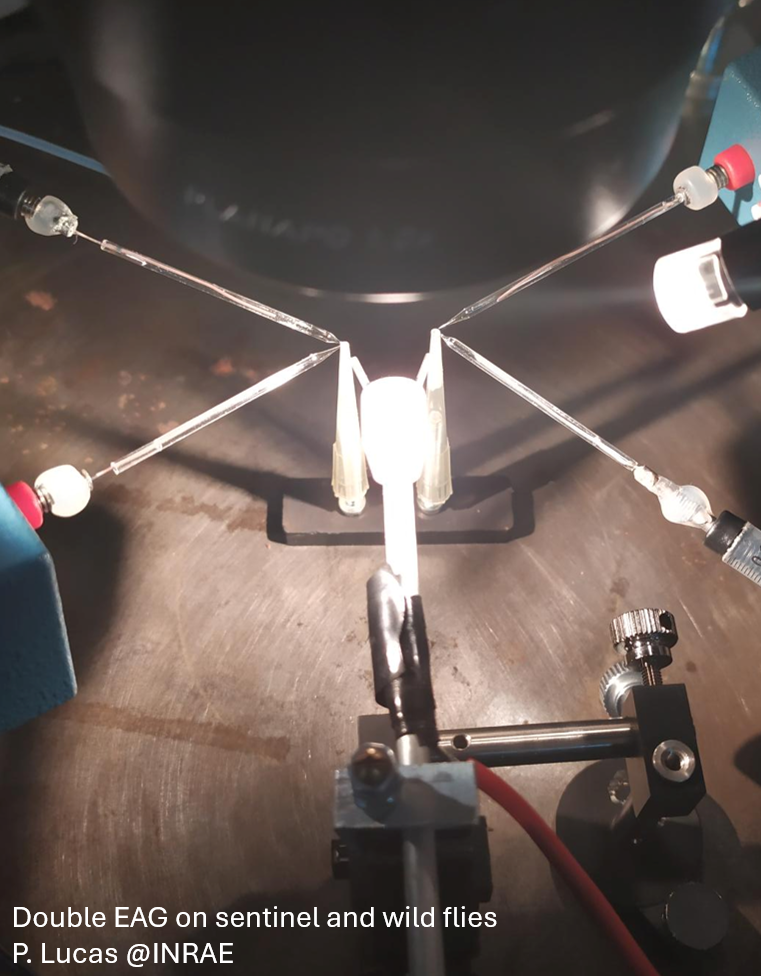
We have developed a portable two-channel EAG (electroantennography) circuit, enabling recording of the olfactory responses of flies.
We have developed a deep learning–based artificial intelligence system to automatically detect pheromone signals from EAG recordings.

Créateur : Just_Super | Crédits : Getty Images