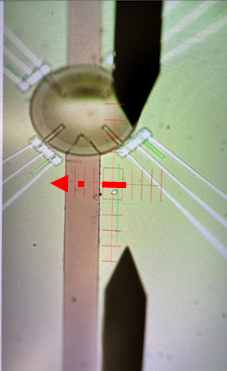
Diamond acoustic resonator developed within the PheroSensor project, currently undergoing mechanical characterization.
WP2 aims to develop a pheromone-based physical sensor capable of detecting the presence of very small quantities of pheromones in the environment, and therefore identifying the presence of the associated pest insect.
The pheromone physical sensor is based in part on the development of a MEMS (Micro-Electro-Mechanical System) acoustic resonator, whose resonance frequency depends on the mass present on its surface — effectively functioning as a microbalance.
This microbalance is made of synthetic diamond, which offers outstanding mechanical properties, in particular a very high Young’s modulus. These properties are exploited to enhance the mass sensitivity of the transducer. The carbon-based and chemically stable surface of the diamond transducer also enables the covalent immobilization of pheromone receptors, which act as a sensitive and selective layer for the sensor.
The pheromone receptors are produced via cell-free expression and stabilized in nanodiscs composed of an artificial apolipoprotein scaffold and a phospholipid bilayer, formed through co-translation in the cell-free system. Indeed, these transmembrane proteins must be stabilized before being immobilized on a sensor.
When pheromones present in the environment selectively bind to the pheromone receptors immobilized on the diamond transducer, the mass increase generated by the trapped pheromones produces a change in the resonance frequency, which is then converted into a measurable electrical signal.
CEA-LIST has extensive experience in the growth and characterization of synthetic diamond for various technological applications, including health, security, and environmental monitoring. The homoepitaxial diamond is produced by microwave plasma-assisted chemical vapor deposition (CVD) and can be boron-doped to make it conductive.
Homogeneous polycrystalline diamond films can be deposited on 10 cm silicon substrates, which are then processed in cleanroom facilities to fabricate sensors. CEA-LIST collaborates actively with ESIEE-Paris ESYCOM on the development of chemical sensors based on this technology.